Sunday, February 19, 2017

Heading South to Puerto Williams, Patagonia

Heading South to Puerto Williams


Torres del Paine 


We left Puerto Natales, the gateway to Torres Del Paine National Park on 30 January after getting a taste of the magnificent the park and also the windy anchorages in or near Puerto Natales.  Sailor types are never allowed much time not to think about the wind down here.  To give you an embarrassing example, one day we hauled our dinghy about 70 feet up a beach and put it beside a building only to discover later that the dingy was going past Motu, down the bay without us, in 30-40 knots.  Bad dinghy!


The Anchorage at Pto Consuelo, near Pto Natales


The trip to Natales is really off the main channels that continue south and east toward Puerto Williams and Cape Horn and it was good to finally get free of these channels and back on track since we fought the gusty wind (rachas) and rain on the way to Natales and got the same treatment when we left. I suspect we paid our dues for the beautiful days in Natales and Torres del Paine National Park.


After the "rachas" of Pto Natales


Since we left Valdivia, where we spent much of the last (southern) winter, the scenery has been getting nothing but more dramatic the further south.  We've again been traveling with our good Canadian friends David and Margaret, on Heart and Soul, a Scepter 43.  They are also new members of the Ocean Cruising Club.


Threading our way through kelp into narrow anchorages


Morning in an anchorage off the Magellan


Sailing the Magellan Straits


Our course led us along the waterways that lead to Puerto Williams, the most southern city (big village) in the world.  Puerto Williams is basically a Chilean Navy Base that allows visitors and yachts.   The Navy, called the Armada, also keeps a very close watch on all vessels down here.  It also is the administrative center for their Antarctica claims.

Once out of the channels leading to and from Natales, we entered Canal Smyth and then into the Estrecho de Magellanes (Strait of Magellan).  This big strait begins in the Atlantic and is well known.  at least the eastern stretch, for its history and bad weather.  It is basically one of two ways to get into Southern Chile from the Atlantic, with the other being the Beagle Canal.  Both can be described as "attention getting" for sailors on small boats.  This general area is where the winds can really blow and where sits a big pile of rocks called Cape Horn!

After Canal Smyth we began investigating ways to get out of the Straits of Magellan and into the Beagle as soon as possible to get into a small channel with less chance of seas and wind.

One such Channel was Acwalisnan which is a pretty Channel with a nasty narrow spot at the south that funnels the current at rather alarming rates.  There is not much of a problem when going thru this area at high tide since predictions are good, but going through at low water is another issue.  Much is written about how to calculate slack at low water and none of the models worked for us.  Neither did asking local fishing and work boats.  We stuck our nose into the narrow bits and it didn't seem impossible so we just nudged a little more and soon found we were in five plus knots against us.  The Beta, our engine, got a work out and Marja was a little annoyed that I wasn't a little more patient.  Lesson learned.  You can teach an old dog new tricks - wait for slack!


Anchorage at Caleta Cinco Estrellas - definitely five stars


Hiking with our buddies Dave and Margaret off the Beagle


Eventually we got out of Magellan and into the Brazo Noroeste de Canal Beagle, also known as the Avenue of the Glaciers.  Our pictures below don't really do the route justice.


Brazo de Noroeste


Italia Glacier


It was finally after about 1750 miles traveled, lots of adventures and many unforgettable anchorages, that Puerto Williams pulled into sight and we tied up at the Club de Yates at the Micalvi.  The Micalvi is an old munitions carrier that was grounded by the Armada and now serves as the dock for yachts to raft outside her.  There are a lot of tales about nights at the Micalvi, but I guess there were too many tales because now no alcohol is allowed.  What do you do with a drunken sailor?


The entrance to Micalvi Club de Yates


Thursday, January 26, 2017

South and East to Pto Natales

January 15, 2017

We are continuing to make our way south as the weather permits.  As previously noted, bad weather rules here and patience is the sailing virtue.  The distance between Puerto Eden, a fishing village of about 250 hearty souls and Puerto Natales, a tourist center of 20,000 people, for visits to the gem of Chilean national parks, Torres del Paine, is about 260 miles without any diversions.  This is an area pretty much without people but lots of exhibits of raw nature from whales to goofy steamer ducks.   We saw our first foreign boat, other than our British Columbia friends on Heart and Soul, since starting this leg of the trip  while anchored in Puerto Bueno (S50 59 and W074 13).  She was a expedition type big powerboat out of New York named Argo.  What a shock!  It also looked pretty comfy.

Keeping in mind that it is summer down here, we’ve been a little surprised at the almost continual rain and the few days where wind drops enough for a comfortable trip even though the wind is almost always behind us.  If the gribs are showing 30 plus knots, you must always be careful to account for gusts that can come roaring off the sides of the fjords that can pack a real wallop.  Our schooner has two hoyt self-tending booms from which we fly a jib and a staysail.  We normally can go “wing and wing” and clip right along. We do not put up the mainsail here due to our worry about gusts.  

However,  the real problem is the rain!   We like to be able to see where we are going.  Yes, we have radar and we use it but in driving squalls, I doubt we would see the small wood Chilean fish boats or bergie-bits (pieces of ice in the channel from the numerous glaciers).  This does not mean we sit in an anchorage waiting for the sun to come out but we do try to avoid the real messy weather days.

For all you sailor friends, for the weather we download primarily four weather models from Predictwind via our Iridium Go satellite modem.  We then stir the tea leaves to figure out what to expect.  We’ve heard many reports that the grip files do not accurately portray what is happening in the channels but we’ve found to the contrary that Predictwind GFS and the GFS models are pretty accurate.  The Euro model doesn’t work so well as it always is over-predicting  the amount of rain and under-predicting the amount of wind.  

We also have an expensive ($500) electronic barometer, an ASI Aquatech Scientific Instruments, that has an amazing ability to forecast coming spells of wind, rain, etc.  The common lore here is the wind precedes the barometer but once again, we have not found this to be the case.

Speaking of weather, we go and travel for days with  barometer readings below 1000 mb.  After all, it is summer.

Our Heart and Soul friends claim summer down here is like winter on Vancouver Island.  They might have a good point since we are running our Antarctic diesel heater pretty much non-stop to keep the temperature in the boat around 67 degrees (19C) in the day and 60 degrees (15C) at night.  The heater on low setting uses about 1.2 gallon (US)  or roughly 3.78 liters, a day.

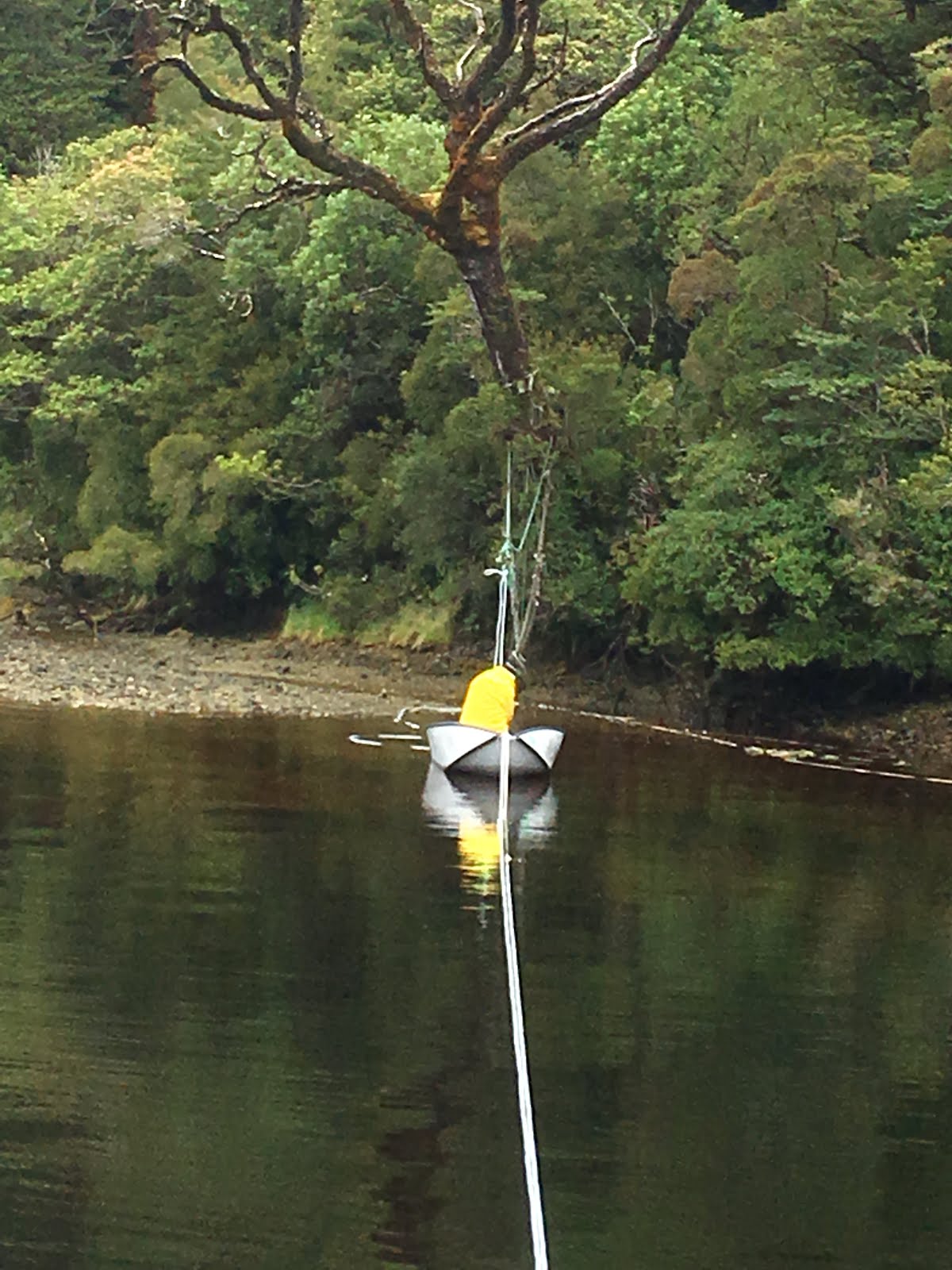
Before ending this blog, Marja is insistent that I mention something about anchoring and tying ashore in each new anchorage.  Many of the caletas are small and deep and require you to take lines ashore.  The trick is to drop the anchor close to shore in reasonably shallow water with the stern facing the direction of the wind and then get out a couple of lines (God Forbid but sometimes more than two).  This all sounds easy but believe me Barnum and Bailey could not come up with a better clown act than the two of us often going through this maneuver.  The reasons are simple, our dear schooner Motu likes to head directly toward the nearest obstruction when in reverse, the wind normally blows the yacht away direction of the wind where you want to tie the boat, and then on top of all that, you risk life and limb attempting to scramble over slimy rocks and a desperate search for a tree or something you can tie to.  


Entering Caleta 


Buying Centolla (king crab) in Pto. Eden


Sailing down the canals, lines for tieing ashore ready to go!


Fast sailing down the canals


Doesn't look like 30 knots, does it?


Finally anchored in Puerto Consuelo near Natales, and finally sun!  And  WIND!!

Tuesday, January 3, 2017

into the Southern Channels of Patagonia


Belated Merry Christmas from Pto. Aguirre
And Happy 2017!!

In Puerto Eden at S 49 08 W 074 25            


The area south of the Gulf of Penas is the real start of the Southern Patagonia Channels if going from north to south.  This is the area of the rugged scenery, bad weather and almost a total lack of people, In short,  it's you, your boat and the wilderness.  This special area is also where you can sail west around the world and your next landfall can be the same place you started from---Patagonia.  Now that would be a challenge way too far for M and I.

We left Castro, the large city known for its houses on stilts and big wood church, as mentioned in last blog, to head south across the Gulf Corcovado.  This area is nice cruising.  You can stay on the west side of the Canal Moraleda and stop at delightful anchorages such as Isla Amita, Isla Jechica---which even has a small marina, and Puerto Aguirre to name just a few but ones we enjoyed.

Anchored in Pto Aguirre with snow-covered
Volcano in background


Further south we started aiming toward Bahia Anna Pink, which has anchorages on this very large bay  and close to the jumping off to go through the Gulf of Penas.

Pto. Millabu, with many waterfalls, and "Rachas" (williwaws)
Bahia Anna Pink

Baking bread while waiting to go South!


Lines out to Shore in Caleta Suarez


Tied in at Caleta Suarez


There are three so-called "choke points", meaning areas of bad weather that need to be transversed, on the way to the end of Patagonia.  The first is the Golfo de Penas, which is a big relatively shallow gulf  that is wide open to thousands of miles of the Pacific.  The distance for a yacht, depending upon which anchorage you leave from, is about 110 miles to 130 miles.  This is also an area  where you sit and wait for good conditions unless you tend to have a masochistic streak or are just plain crazy.  (The  other "chock points" are Magellan Strait and  Canal Breaknock)


Whale Bones discovered in Estero Cono, Caleta Suarez


And wait we did for almost two weeks for a decent weather window allowing us to leave on the 28th of December, along with our Canadian friends, David and Margaret, on Heart and Soul.  We left the protected anchorage of Caleta Suarez, which is used by fisherman.  It is a lovely spot and appears to be free of "rachas" (williwaws) that rocked us in Caleta Cliff.  As is typical in many anchorages, you drop a bow anchor in Suarez and then tie a couple of lines (or more) to shore.  Very Secure.

This anchorage can get crowded with small but seaworthy fishing boats awaiting good weather but we only saw one Chilean fish boat, and this was over Christmas, with four young friendly guys onboard. Christmas dinner was aboard Heart and Soul, whom we have more or less been sailing with.  Margaret made a fantastic traditional Christmas dinner with turkey and everything else.  It made the four of us feel closer to families and friends far north.


Christmas in Caleta Suarez on Heart and Soul
with Dave and Margaret


After a wait of two weeks, we got a decent weather window and motor-sailed across the Gulf of Penas in lumpy but otherwise excellent conditions.


The photos will show some of the beautiful anchorages going down the Canal Messier Channel, including Seno Iceberg, and currently, the small village of Eden, with its colorful houses and boardwalks connecting inhabitants around the bay.  A young German singlehander aptly described the town and area as the "end of the world."


Calmer conditions - Messier Channel ahead

We made it!


Stephen's handy improvised kelp cutter.


Glacier at Seno Iceberg


Brrrrrr. 


Anchorage at Puerto Eden, Heart and Soul and Motu


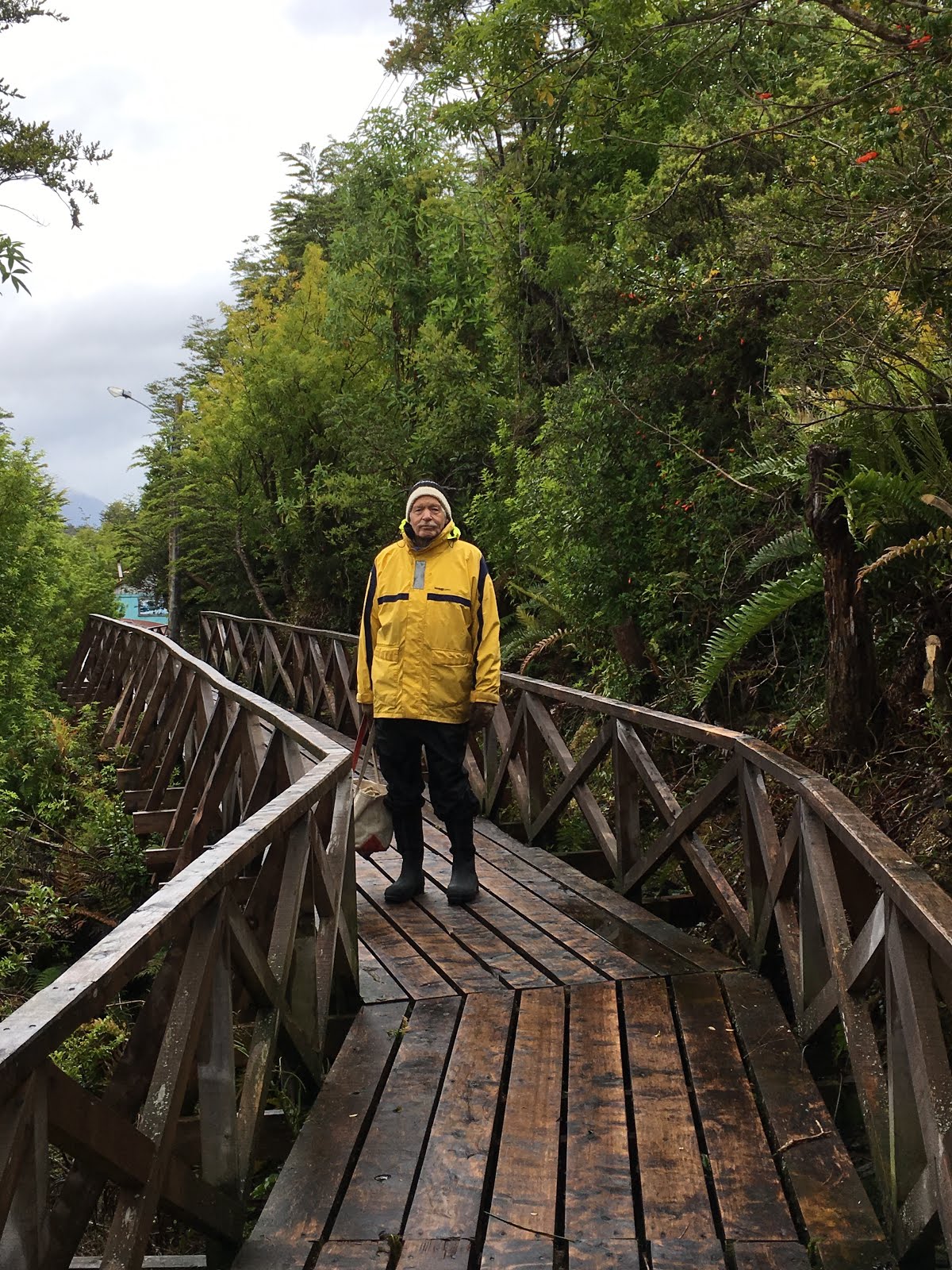
The boardwalks of Pto. Eden


Shopping at Lolo's store in Pto Eden


Wednesday, November 30, 2016

Patience and Timing Going South


Nov. 30, 2016
S 42.34.7 W 073 45.4  Isla Chiloe, Chile

Our patience for a good weather window finally paid off after a two week wait in Valdivia.  We departed a lovely anchorage near the exit of river that flows out of a confluence of rivers surrounding Valdivia, in company with our Canadian friends,  David and Margaret on Heart and Soul, on the 23rd of November.  It was a rather uneventful motor sail with somewhat sloppy seas, our good friend, the Humboldt current against us, and engine rpms at 2000, for the 130 mile dash to the Chacao Channel.

Heading to sea

Timing is everything when going through the Chacao Channel (the passage between the mainland and Chiloe Island)  with its strong currents so we spent the night at a little bay, called Godoy, 12 miles north of the channel for an early entrance at 0730.  The passage through the channel was actually a lot of fun.  We were doing 9 to 11.7 knots the entire way with the engine giving rpms for our normal 5 knots of motoring speed.  Marja and I learned long ago that sailing is a wonderful way of life but it ain't exactly life in the fast lane.  We decided we could get used to this ten knot speed!

Young man at Godoy selling seaweed for eating or shampoo
Thanksgiving and Canada Day celebration in Caleta Godoy

Godoy Anchorage


Departing Chacao
In Chacao Channel
After the Canal, we went looking for an anchorage for a couple of days to wait out some pesky rain and ended up Anihue island, which is one of several very pretty islands clustered together in the northern part of the Gulf of Ancud.  

One of the approximately 60 wooden churches in  Chiloe
In the garden of Dora, a resident of Village Anihue and local
oyster woman, with Margaret from Heart and Soul
Low tide in Anihue

After a few days of at Village Anihue, we headed south once again, this time toward Castro.  The city is the largest on Chiloe, and is a nice city known for its large wooden church, houses on stilts, and pastoral surrounding areas.  The church, unfortunately for us but not for the church, is undergoing some major interior construction work, and was closed for the moment.


Iglesia de Castro


Life on the water in Castro, Chiloe.  Colorful
Palafitos are built on stilts over the water.


After topping up with supplies we returned to Marina Quinched and finished getting ready for points south.  


Monday, November 21, 2016

The wonderful people of Alwoplast - Lorena
our lifesaver and her friend Samantha!
Bariloche, Argentina

Nov. 21
Valdivia (39 50S and 73 19W)

Marja and I woke up this morning and felt like the boy or girl all dressed up for the prom but without a date.

It's sunny and warm here today and we are still tied to the dock at Alwoplast boatyard about nine miles down the river from Valdivia.  We love it here but as local lore goes, when it is sunny and warm in Valdivia, it is windy outside in the ocean.  Windy outside today and for past two weeks means 15 to 30 knots on the nose.  O yes, a sailor must not forget about the Humboldt current that is running about .6 kt average from south.  Things get really interesting when wind shifts to the north and the seas build.

There is a level of hope, however, and we plan to leave dock today and go anchor at a small island, Isla Mancera,  near the river exit for the 130 mile dash down the coast to Channel Chacao and into the Gulf of Ancud, which leaves you only about 200 to 250 miles south to the next ocean crossing, called the Gulf of Penas.

Our Canadian friends, David and Margaret, on Heart and Soul, and our Brazilian friends Kiko, his sister, and friend, Martine (who won an Olympic Gold medal in sailing in the Rio Olympics this past summer)  are also a bee-hive of activity for final jobs you always forget about on a boat until you are ready to untie lines.

On Motu, we have 1150 liters of fuel, 500 liters of water and enough food to feed India for a month, and most importantly the GFS and EURO weather models in agreement.

Today in cruising, it is just as important to be alert to a possible bureaucratic storm as it is to watch the weather.  The officials dealing with yachts in Chile, with the Armada being foremost in these dealings, are fantastic, extremely helpful and friendly, and totally honest.  However, this is really a good thing because there is a lot of paperwork for yacht crews in Chile.

With this in mind, we recently climbed on a bus (paid more for the luxury seats---worth it) and headed to Bariloche, Argentina,  to get new 90-day visas.  We were worried about getting half-way to Puerto Williams, the far south, to discover our visas had run out.

Bariloche is an upscale ski resort set up in the Andes next to a big lake.  The scenery is breathtaking but it can get quite chilly at night in the spring and does the wind blow across the lake.  Everything went according to plan so we should avoid the paperwork worries for a time.

Hope everyone has a nice Thanksgiving and if your not an American, a nice lovely meal with wine on that date wherever you are.


The colorful and wonderful market of Valdivia


Waterfront of Valdivia


Rio Calle-Calle in Valdivia


Our favorite coffee shop in Teja
Winter fun - insulating!                              


Successful haul out at Alwoplast
Bus to Bariloche, Argentina to renew visas


Canadian flagged Heart and Soul
Dave and Margaret aboard
Brazilian Cruisers Kiko, Martine and Marcia
The most excellent yard manager at
Alwoplast boatyard
French Flagged Skoiern with cruising friends
Patrick, Anne Marie and Zoe